Do You Know Dr. Skanis?


For today’s Wellness Wednesday, UAF SHCC would like to introduce one of it’s counselors. For those of you who don’t know her, Dr. Marie Skanis (she/her/hers) is our newest counselor who joined the Student Health team in January 2020. One of her pet peeves is expressed in this post, inspired by @drjenpsychology and @brenebrown. 


Let’s learn to replace the saying “Good vibes only” with “all the feels”. Whether you feel pressured from those around you, society, or you feel uncomfortable experiencing emotions that are not considered “good”, Marie would invite you to resist the urges to censor your emotions. In fact she’d like you to stop doing that. Telling yourself on the daily that only certain emotions are worthy can invalidate large swaths of experience. Our emotions can serve vital purposes if only we attend to them and develop the ability to experience them. As a comparison, it would likely be harmful to ignore physical pain sensations. Pain is difficult to experience, but it gives your body important information. At times it may serve as a warning for things to avoid, such as pain you feel if you accidentally touch that hot pan or stretch with poor form. Emotions, too, can help us recognize important things: when we have unmet needs, feel hurt by others, are drained by a situation, have had our boundaries crossed, etc. In this way, experiencing emotions is just one building block in things like maintaining self-esteem, healthy relationships, mental health, and motivation. Check out @drjenpsychology and @brenebrown for more great information on mental health. Also, check out Brene Brown’s podcast Dare to Lead, where she discussed with guest Dr. Susan David how experiencing the range of your of emotions can be healthy. 


#nanooknation #universityofalaska #mentalhealth #mentalhealthmatters #mentalhealthawareness #mentalwellness #allthefeelswelcome 

Talking About Race


Looking for concrete ways to engage in allyship? One way is developing the ability to talk about race. We’re inspired this week by the following post from @psychforthepeople: 


Talking about race constructively is really difficult. However, when we can, it can heal racial and ethnic divides while reducing prejudice and misinformation. So, what gets in the way of talking about race? 

Talking about race is so hard because: 


* We exist in a white supremacy culture that silences any potentially “offensive” or “uncomfortable” topics. 

* When we do talk about race, it triggers and heightens powerful, uncomfortable emotions (for example, defensiveness, anxiety, anger, and helplessness) that are often deemed “unprofessional” in academic and/or work spaces. 

* Talking about race can challenge people’s entire worldviews, which can feel threatening to the idea that one exists in a fair and just world. 

* For People of Color, talking about race with others could expose them to discriminatory, hurtful, and/or invalidating statements. 

* For white people, talking about race with others can be hindered by fears of appearing racist, of realizing their racism, of acknowledging white privilege, and of taking responsibility to combat racism. 


How do we start to talk about race in light of all of these difficulties? Research* has pointed to the importance of the ability to acknowledge, validate, and facilitate discussion of feelings as being crucial to successful dialogues about race. 


What does this look like? In a recent conversation I had about race: 


* I noticed my shoulders tensing and my heart racing

* I asked myself, “What am I feeling?”

* I labeled my feeling as “anxiety”

* I then asked myself, “What is this feeling telling me?” Anxiety was telling me that this conversation about race was challenging my worldview. 

* I was in a supportive space, so I went an extra step and shared my feelings, saying, “I’m noticing I’m feeling anxious right now because this conversation is challenging me to reevaluate my worldview.” It felt vulnerable, but allowed space for people to really understand where I was at and share their similar experiences of what it felt like for them to reevaluate their worldview. 


Remember: If you want to talk about race, it will feel uncomfortable at some point because a lot of people were not raised with language or norms that made talking about race feel comfortable. Being able to identify and talk about uncomfortable feelings can feel new, overwhelming, and vulnerable - that’s okay! Engaging in activities that get you more in touch with your feelings such as journaling, grounding exercises, or talking to other supportive people can serve as a great starting point. 


* Sue, D. W. (2013). Race talk: The psychology of racial dialogues. American Psychologist, 68(8), 663. 


#blacklivesmatter #antiracism #allyship #education #psychology #mentalhealth #nanooknation 

Building Racial Sensitivity

This week we’d like to share a post from @psychforthepeople about how to build racial sensitivity. Working toward anti-racism starts with developing awareness of your own racial identity. Before you can fully appreciate how race impacts everyone in the U.S. today, it is necessary to start with understanding how race impacts you. This can be really challenging and, at times, painful. 


So, where do you start? Here’s a list of questions that can be used to begin exploring your racial identity (Adapted from Laszloffy & Hard, 2000*): 

  • How do I define myself racially? 

  • When did I first become aware of race/skin color in general, and mine in particular? 

  • What messages did I learn about race/skin color based on that first experience? 

  • What direct and indirect messages did I receive about race/skin color from my family and friends throughout my childhood? My adulthood?

  • How did the messages that I received about race/skin color affect how I thought and felt about myself and others racially? 

  • What benefits was I denied because of my race/skin color? 

  • What is the racial makeup of the people I choose to date, befriend, and/or associate with?

Answering these questions can be a helpful starting point for folks who may feel lost in knowing how to begin exploring their racial identity. They are not simple questions to answer nor are the answers you come up with today going to remain the same throughout your lifetime. Importantly, continually exploring how your answers evolve and hearing others’ answers to these questions can begin to build your racial sensitivity (that is, your ability to empathize and relate to others’ racial experiences and to adjust and accommodate your behaviors accordingly). Racial sensitivity is an essential component of interacting with people from diverse backgrounds respectfully and compassionately. Being a person of color in the US necessitates developing a high level of racial sensitivity to learn to adapt to living within white supremacy culture. Being white in the U.S. means that racial sensitivity is not necessary because others were expected to adapt to white norms. Therefore, this list of questions can be particularly meaningful for white-identified people to engage with. 


*Laszloffy, T. A., & Hardy, K. V. (2000). Uncommon strategies for a common problem: Addressing racism in family therapy. Family Process, 39(1), 35-50. 


#nanooknation #universityofalaska #shcc #blacklivesmatter #antiracism #allyship #antiracist #psychology #mentalhealth #race #racism #activism #socialjustice #psychforthepeople 


White Racial Identity Development


The events of the past month have us thinking about what it means to be white. Exploring what a white racial identity is a process. For fellow white students, we encourage you to think about these stages as part of the development of a healthy white racial identity. As @psychforthepeople shared, the work of Dr. Janet Helms illuminates what it means to develop a healthy white racial identity. The process involves becoming consciously aware of the ways in which racism advantaged white people and deliberately  working towards an antiracist perspective. Dr. Helms outlines 6 stages of white racial identity development: 

  1. Contact: ignorance or obliviousness to race and racism in the United States (for example, by  viewing racism as an issue of the past when Barack Obama was elected President of the U. S. in 2008). 


  2. Disintegration: Becoming aware of race-related issues and feeling confused (for example, hearing about George Floyd’s murder and not knowing how to react because you thought racism did not exist anymore). 


  3. Reintegration: Idealization of white culture and intolerance of non-white culture (for example, believing that white people are superior to everyone and that Black people are to be blamed for their own problems). 


  4. Pseudo-independence: Starting to think and learn about racial issues without necessarily integrating them into one’s own life (for example, being open to reading books about racism, but still not recognizing ways in which you are a part of racist systems). 


  5. Immersion/Emersion: Attempting to redefine Whiteness from an antiracist perspective and to reeducate other white people (for example, being more willing to truly confront one’s own biases and to talk to other white people about racism).


  6. Autonomy: Increasing awareness of Whiteness, reduced feelings of guilt, acceptance of one’s own role in perpetuating racism, and willingness to give up benefits of racism in favor of working toward an antiracist society (for example, feeling more comfortable in openly talking about and challenging white identity and in being more involved in antiracist efforts). 


Understanding your own racial identity is crucial in learning how to interact with people from diverse backgrounds respectfully and compassionately. It is important to note that these stages are not necessarily linear - one can move between them depending on different situations. It takes consistent work to move amongst these stages toward autonomy. Read more about white racial identity development: Helms, J. E. (1993). I also said, “White racial identity influences white researchers”. The Counseling Psychologist, 21(2), 240-243. 


#uafshcc #nanooknation #universityofalaska #antiracism #blacklivesmatter 

Thursday Group: A Nonbinary, Genderqueer, Genderfluid, Gender Non-conforming, Trans Identifying & Gender Questioning Support Group


Are you looking for a supportive community where you can explore your identity, give and receive support from your peers and be in a safe, non-judgemental environment?

Join us beginning this Thursday from 1-2! A Nonbinary, Genderqueer, Genderfluid, Gender Non-conforming, Trans Identifying & Gender Questioning Support Group held via Zoom.

Please email uaf-sh-cc@alaska.edu for the meeting link and password.  We hope to see you there!

Mindful Mondays


New group starting January 25th at 12:30pm!  There is a lot of talk about mindfulness, are you curious?  Having a mindfulness practice can be beneficial to those under a lot of stress, experiencing depression or anxiety, sleep disturbances or other mental health concerns.  Mindfulness is also a valuable tool to add to your self-care kit so come join us and see how it may benefit you!

The group is offered through Zoom and will run until March 1st.  For more information, please contact Sarah Jensen at 907-474-7043.

Take Charge Tuesdays!

Hello students and welcome back to Spring semester!  Why not get a jump start this semester by joining our Take Charge Tuesday group?  

Taking Charge of Your Headspace will meet every Tuesday via Zoom throughout the semester to support you and keep you on track to finish the year strong.  Join one or join them all! Just click the QR code or link to attend the topic of your choosing.

We hope to see you there!


Covid-19 Testing - ONLINE Scheduling!!!


Stay Well UAF

We may be nearing the end of 2020, but many of us continue to struggle with increased feelings of stress, sadness, and worry.  Check out @loveislouder for resources and information on how to stay safe, healthy and connected as we continue to navigate these challenges. 

We're almost there folks!


 #nanooknation #universityofalaska #loveislouder #loudertogether #staysafe #stayin #staycalm #staykind #stayactive #stayconnected

loveislouder.org a Project by @JEDfoundation 

Holiday Stress

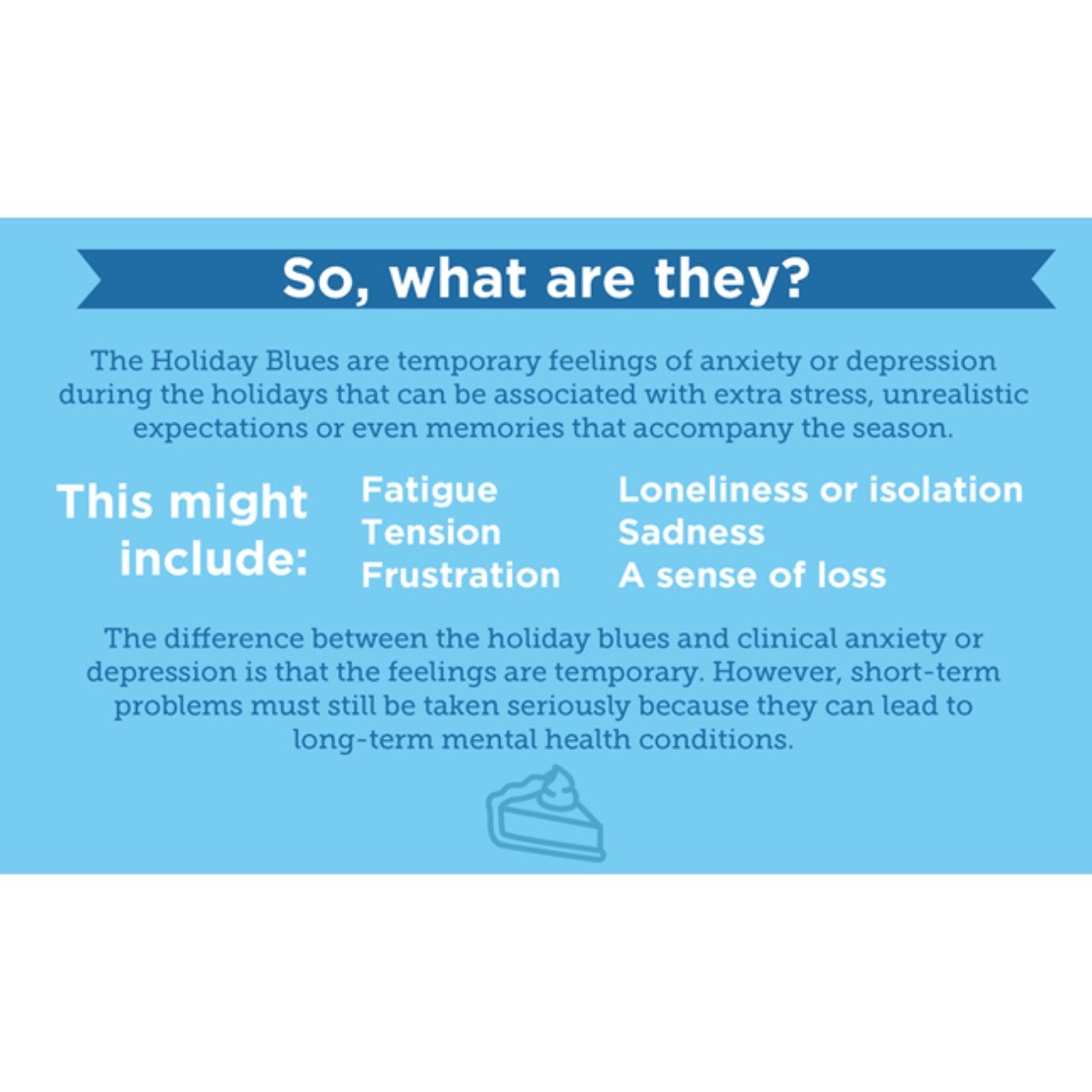
Let’s be real, sometimes the holidays are stressful. You aren’t alone if you feel that way. Here are some signs to look out for that you’re having the holiday blues and tips to help avoid them. 


#holidayblues #mentalhealth #mentalhealthmatters #staysafe #stayin #staycalm #mentalhealthawareness #nanooknation #universityofalaska 


Sources: https://www.nami.org/blogs/nami-blog/november-2015/tips-for-managing-the-holiday-blues

https://arborplaceinc.org/2019/12/19/how-to-manage-stress-mental-health-during-the-holidays/


Holiday Self-Care

Holidays can be a wonderful break in the school year.  We also recognize and acknowledge that many of us will be spending the holidays in ways we are not used to this year.  Here are some ways to help yourself and your community be resilient over the holiday break.


Student Health & Counseling will be closed from December 21 until Jan 4.  However, should you have an urgent mental health need, there is a hotline available any time we are not open.  Simply call the front desk at 474-7043 and follow the prompts to reach a crisis counselor.  We wish you a safe and happy holiday break!

 #mentalhealth #mentalhealthmatters #staysafe #stayin #staycalm #mentalhealthawareness #nanooknation #universityofalaska  


Happy Holidays from SHCC

 Winter break is here!  As you head home or stay close for the holidays, we at Student Health and Counseling wish you rest, rejuvenation and good health!

During the winter break, we hope you will do your part to reduce the spread of COVID-19. Here are some tips from the Alaska Department of Health and Social Services to help you stay safe and care for your community.


#stopthespread #covidsafe #staysafe #stayin  #nanooknation #universityofalaska 


Source: http://dhss.alaska.gov/dph/Epi/id/Pages/COVID-19/general.aspx


What is Racism?

Crucial to improving equity at UAF is understanding one factor that erodes it: racism. I encourage us all to take time this week to think about what you hear when people talk about racism around you. What do you believe racism is? The way the term has been used seems to have changed over time1. As you consider how you’ve defined racism, consider the following factors:

 • How visible is racism?

 • Who perpetrates racism?

 • What makes something racist? 

 These definitions and examples may miss some ways racism shows up. They are meant to be frameworks for you to consider. The more you are able to recognize some forms of racism, the more capable you will be of taking action when you see racism. 

How visible is racism? 

Some racism is overt and some is covert and less visible. Overt racism is often the easiest to identify and act against. For instance, harassment of non-English speakers, actions of the KKK, and use of the “N” word are all very easy to spot. In recent decades, the word racism has come to be used more frequently to describe covert racism. Covert racism includes actions that subvert, distort, restrict, and deny racial minorities access to privileges and benefits others in society get2. This type of racism is disguised enough that, when pointed out, a person can deny the act was racist2. This process can people who witness racism question whether to label an act “racist”. 

Who can perpetrate racism? 

Racism shows up in the actions of individuals, small groups, organizations, and large systems. Individual racism may be easier to identify because a specific instance can be highlighted between two people that shows racism. Systemic racism can be more difficult to identify because it often is only visible to those who have access to the experiences of entire groups of people with given systems. For instance, one mother losing her baby during birth may not necessarily signal her doctor was racist. However, studies examining the experiences of Black and/or African American mothers have revealed an infant mortality rate 2.3 times higher than in non-Hispanic white mothers3,4,5. Anyone and any system can exhibit racism. There are some definitions of what racism is that suggest there are racial groups whose actions cannot be defined as racist. 

What does it mean to call something racist? 

One definition, which comes from Dr. Ibram X. Kendi’s book How To Be An Antiracist, states that a racist is “One who is supporting a racist policy through their actions or inaction or expressing a racist idea.” (Kendi, p. 13). Take a moment to notice parts of that definition. The definition ignores intention. A person could then have good intention, yet still be supporting racist ideas or policies. The term specifically is applied to an action or inaction. It is not, then, the person’s character that is being described as “racist”. Consider what this means. On the one hand, it means that by this definition one’s total and permanent character is not being threatened by the word. On the other hand, it means no amount of good intention or moral character gives you a pass to not be mindful of your behavior. 


These frameworks are not the same as others might use. I encourage you to ask yourself: how does my definition of racism facilitate or hinder my ability to identify racism in myself? In others? What does my definition focus on? What might my definition miss? 


Resources 

1: See piece in The Atlantic titled Racist is a Tough Little Word at https://www.theatlantic.com/ideas/archive/2019/07/racism-concept-change/594526/ 

 2: See Fitchburg State University’s antiracism resource website at https://fitchburgstate.libguides.com/c.php?g=1046516&p=7619360 

 3: US. Department of Health and Human Services, Office of Minority Health. See further information at https://minorityhealth.hhs.gov/omh/browse.aspx?lvl=4&lvlid=23 

4: Science News’ description and interview with authors of study which found lower African-American infant mortality rate when the physician was also African-American/Black. https://www.sciencenews.org/article/black-newborn-baby-survival-doctor-race-mortality-rate-disparity 

 5: Original journal article of study examining impact of physician/patient racial concordance on infant mortality. https://www.pnas.org/content/117/35/21194 6: Kendi, I. X. (2019). How to be an antiracist. New York City, NY: One World publishing.

Help is out there...


If you or someone you know is struggling with a mental health challenge, there is help available.


Student Health & Counseling right here on the UAF campus is your confidential resource.  Call (907) 474-7043 to make an appointment with one of our counselors.


Or reach out to the National Suicide Prevention Lifeline 

800-273-TALK (8255)


International? Visit https://www.iasp.info/

To find suicide prevention resources no matter where you are in the world


#SuicidePreventionMonth #bethe1to #nationalsuicidepreventionlifeline #NanookNation